


According to Bob Diamond, it was a big boy wot dunnit and he ran away.
The trouble is it is always somebody else's fault and they are too far down the organisation for it to be the responsibility of the CEO. But if Mr Diamond is not responsible for their actions, why does he trouser part of the profits they generate as his bonus.
The problem, as many are beginning to realise is not just one of risk, but also of culture.
Three years ago I wrote a blog blaming the entire financial crisis on Tie Rack. OK, it was a bit tongue in cheek, but the underlying message, that traders (who like to call themselves investment bankers) have taken over the previously sleepy and conservative banks and get to play all day with your government guaranteed deposits. The solution is to change the banks by separating out trading activities and to remove CEO's like Mr Diamond who in their entire banking lives have not lent a penny to a corner shop or engineering start up (unless their loans were wrapped up in securitised packaged of bankers acceptances and short term receivables), and replace them with honest lenders who at a minimum don't try to mess with regulators, statutory reporting, tax avoidance or rate reporting and fixings.
|
|
|
|
|
Friday, 29 June 2012


Thursday, 28 June 2012
Done .... for you bigboy
There was a time when big banks didn't let traders near the senior executive washroom. The fear was that traders are natural predators, risk-takers, rule-benders who would stop at nothing to make a buck. Shame was that in the nineties and noughties, trading edged out and subsumed the rest of every bank. Here is why the earlier bankers' instincts were right (taken from the FSA report into Barclays):
We have another big fixing tom[orrow] and with the market move I was hoping we could set [certain] Libors as high as possible.
Requests to move Libor rates were frequently accepted by Barclays’ submitters, who emailed responses such as this, written in response to a swaps trader's request for a high one-month and low three-month US Dollar Libor on March 16, 2006:
Other responses included the phrases: “always happy to help” and “Done…for you big boy”.
For you ... anything. I am going to go 78 and 92.5. It is difficult to go lower than that in threes. looking at where cash is trading. In fact, if you did not want a low one I would have gone 93 at least.March 16, 2006, submitter's response to swaps trader's request for a high one-month and low three-month US Dollar Libor
[Senior trader] owes me! February 7, 2006, submitter's response when swaps trader called him a "superstar" for moving Barclays' US Dollar Libor submission up a basis point more than the submitter wanted and for making a submission with the intent to get "kicked out"According to the CFTC senior managers even coined the phrase “head above the parapet” to describe putting in high Libor submissions relative to other banks.
Sometimes, the traders asked the submitters to try to have Barclays excluded from the Libor calculation altogether by deliberately falling into the top or bottom quartile, in an attempt to influence the official fixing. Sometimes the requests covered several days or even weeks of submissions at a time.
WE HAVE TO GET KICKED OUT OF THE FIXINGS TOMORROW!! We need a 4.17 fix in 1m (low fix) We need a 4.41 fix in 3m (high fix) November 22, 2005, senior trader in New York to trader in London
You need to take a close look at the reset ladder. We need 3M to stay low for the next 3 sets and then I think that we will be completely out of our 3M position. Then its on. [Submitter] has to go crazy with raising 3M Libor. February 1, 2006, trader in New York to trader in London
Your annoying colleague again ... Would love to get a high 1m Also if poss a low 3m... ifposs ... thanks February 3, 2006, trader in London to submitter
This is the [book's] risk. We need low 1M and 3M libor. PIs ask [submitter] to get 1M set to 82. That would help a lot March 27,2006, trader in New York to trader in London
Hi Guys, We got a big position in 3m libor for the next 3 days. Can we please keep the libor fixing at 5.39 for the next few days. It would really help. We do not want it to fix any higher than that. Tks a lot. September 13, 2006, senior trader in New York to submitter
For Monday we are very long 3m cash here in NY and would like the setting to be set as low as possible ... thanksDecember 14, 2006, trader in New York to submitter
PIs. go for 5.36 Libor again tomorrow, very long and would be hurt by a higher setting ... thanks. May 23, 2007, trader in New York to submitter
The following are just some of the numerous examples of the communications between the traders and submitters:
June 1, 2006: Senior euro swaps trader: "Hi [Euribor Submitter], is it too late to ask for a low 3m?"
Euribor submitter: "Just about to put them in ..... so no."
September 7, 2006: Senior euro swaps trader: "I have a huge 1m fixing today and it would really help to have a low 1m tx a lot."
Euribor submitter: "I'll do my best."
Senior euro swaps trader: "because I am aware some other banle need a very high one ... .if you could push it very low it would help. I have 50bn fixing."
October 13, 2006: Senior euro swaps trader: "I have a huge fixing on Monday ... something like 30bn 1m fixing ... and I would like it to be very very very high ..... Can you do something to help? I know a big clearer will be against us ... and don't want to lose money on that one."
Euribor submitter forwarded the request to another Euribor submitter, advising: "We always try and do our best to help out. .... "
Senior euribor submitter to senior euro swaps trader: "By the way [euribor submitter] tells me that it would be good to see a high lmth fix on Monday, we will pay for some cash that morning so hopefully that will help."
January 12, 2007: Senior euro swaps trader: "hi [Euribor submitter]. we need a low 1m in the coming days if u can .... "
Senior euribor submitter: "hi [senior euro swaps trader], we will keep the 1mth low for a few days."
April 2, 2007: Euro swaps trader: "hello [Senior Euribor Submitter], could you please put in a high 6 month euribor today?"
Senior Euribor submitter: "will do."
July 29, 2008: Euro swaps trader to senior euro swaps trader: "I was discussing the strategy [to get a high fixing] with [Senior Euribor Submitter] earlier this morning - today he will stay bid in the mkt and put a high fixing but without lifting any offer, and then he will be really paying up for cash tomorrow and Thursday which is when the big positive resets are."
We have another big fixing tom[orrow] and with the market move I was hoping we could set [certain] Libors as high as possible.
Requests to move Libor rates were frequently accepted by Barclays’ submitters, who emailed responses such as this, written in response to a swaps trader's request for a high one-month and low three-month US Dollar Libor on March 16, 2006:
Other responses included the phrases: “always happy to help” and “Done…for you big boy”.
For you ... anything. I am going to go 78 and 92.5. It is difficult to go lower than that in threes. looking at where cash is trading. In fact, if you did not want a low one I would have gone 93 at least.March 16, 2006, submitter's response to swaps trader's request for a high one-month and low three-month US Dollar Libor
[Senior trader] owes me! February 7, 2006, submitter's response when swaps trader called him a "superstar" for moving Barclays' US Dollar Libor submission up a basis point more than the submitter wanted and for making a submission with the intent to get "kicked out"According to the CFTC senior managers even coined the phrase “head above the parapet” to describe putting in high Libor submissions relative to other banks.
Sometimes, the traders asked the submitters to try to have Barclays excluded from the Libor calculation altogether by deliberately falling into the top or bottom quartile, in an attempt to influence the official fixing. Sometimes the requests covered several days or even weeks of submissions at a time.
WE HAVE TO GET KICKED OUT OF THE FIXINGS TOMORROW!! We need a 4.17 fix in 1m (low fix) We need a 4.41 fix in 3m (high fix) November 22, 2005, senior trader in New York to trader in London
You need to take a close look at the reset ladder. We need 3M to stay low for the next 3 sets and then I think that we will be completely out of our 3M position. Then its on. [Submitter] has to go crazy with raising 3M Libor. February 1, 2006, trader in New York to trader in London
Your annoying colleague again ... Would love to get a high 1m Also if poss a low 3m... ifposs ... thanks February 3, 2006, trader in London to submitter
This is the [book's] risk. We need low 1M and 3M libor. PIs ask [submitter] to get 1M set to 82. That would help a lot March 27,2006, trader in New York to trader in London
Hi Guys, We got a big position in 3m libor for the next 3 days. Can we please keep the libor fixing at 5.39 for the next few days. It would really help. We do not want it to fix any higher than that. Tks a lot. September 13, 2006, senior trader in New York to submitter
For Monday we are very long 3m cash here in NY and would like the setting to be set as low as possible ... thanksDecember 14, 2006, trader in New York to submitter
PIs. go for 5.36 Libor again tomorrow, very long and would be hurt by a higher setting ... thanks. May 23, 2007, trader in New York to submitter
The following are just some of the numerous examples of the communications between the traders and submitters:
June 1, 2006: Senior euro swaps trader: "Hi [Euribor Submitter], is it too late to ask for a low 3m?"
Euribor submitter: "Just about to put them in ..... so no."
September 7, 2006: Senior euro swaps trader: "I have a huge 1m fixing today and it would really help to have a low 1m tx a lot."
Euribor submitter: "I'll do my best."
Senior euro swaps trader: "because I am aware some other banle need a very high one ... .if you could push it very low it would help. I have 50bn fixing."
October 13, 2006: Senior euro swaps trader: "I have a huge fixing on Monday ... something like 30bn 1m fixing ... and I would like it to be very very very high ..... Can you do something to help? I know a big clearer will be against us ... and don't want to lose money on that one."
Euribor submitter forwarded the request to another Euribor submitter, advising: "We always try and do our best to help out. .... "
Senior euribor submitter to senior euro swaps trader: "By the way [euribor submitter] tells me that it would be good to see a high lmth fix on Monday, we will pay for some cash that morning so hopefully that will help."
January 12, 2007: Senior euro swaps trader: "hi [Euribor submitter]. we need a low 1m in the coming days if u can .... "
Senior euribor submitter: "hi [senior euro swaps trader], we will keep the 1mth low for a few days."
April 2, 2007: Euro swaps trader: "hello [Senior Euribor Submitter], could you please put in a high 6 month euribor today?"
Senior Euribor submitter: "will do."
July 29, 2008: Euro swaps trader to senior euro swaps trader: "I was discussing the strategy [to get a high fixing] with [Senior Euribor Submitter] earlier this morning - today he will stay bid in the mkt and put a high fixing but without lifting any offer, and then he will be really paying up for cash tomorrow and Thursday which is when the big positive resets are."
It could only be Barclays
If I ever met a dishonest banker, chances are they had probably worked at Barclays, or maybe Lehman or some other second tier investment bank, but it was always Barclays that seemed to have a culture of dishonesty, in the same way that Arthur Andersen or Enron had that extra spiviness that set them apart from the rest. Barclays, as we know, used to make most of their money either from tax scams using their own tax position or by taking deals to other banks to use theirs. As a bank, they were never any good
And so it would seem from the reports of their alleged manipulation of the LIBOR and EURIBOR rates. What is that all about? Well if you have ever signed a floating rate loan or swap agreement with a bank (standard practice for companies), then you will see a clause explaining how the floating rate of interest is calculated. For a loan it is the LIBOR rate at 11 am on the fixing date, and that value is calculated as the average value as reported by a panel of banks as the rate at which they offered to take deposits at that time.
The theory being that by taking an average of several large banks, any blips in the market would be smoothed out, and because the rates at which they were offering to take deposits would be a matter of public record, any misreporting would eventually be discovered, so any bank that did so would not only be dishonest, but also stupid. Barclays, it appears, were both.
By reporting a higher LIBOR than they were offering, a bank would push up the marginal cost to floating rate borrowers. There could well be other instances when a big derivatives play might be "helped" by a lower reporting of LIBOR. The FSA reports don't go into detail of any losses but they do record emails demonstrating collusion. If the bank made money from it, then their customers and counterparties lost. Shame then that the government pockets the £290 million fine and doesn't pass it back to the customers.
Bob Diamond will forego his bonus for this year, but since the FSA has known about the problem since 2004, is there any chance he will be handing back his bonuses for the last 10 years? Fat chance.
And probably fat chance of any fraud prosecutions.In a world where you can get a long prison sentence for stealing a bag of rice, organising a demo to which know one turns up or assisting US Customs to break their own rules to export weapon components that don't exist, it seems that the punishment for systematic long term financial fraud by the chief executive of a bank is to have to settle for a £5 million salary, well £17 million when you count share scheme payouts, or make that £100 million since 2006.
In a statement Diamond said: "Nothing is more important to me than having a strong culture at Barclays. I am sorry that some people acted in a manner not consistent with our culture and values." Given Barclays, internal culture, it is easy to see Diamond's point. Barclays' "culture and values" have made him a lot of money over the years.
And so it would seem from the reports of their alleged manipulation of the LIBOR and EURIBOR rates. What is that all about? Well if you have ever signed a floating rate loan or swap agreement with a bank (standard practice for companies), then you will see a clause explaining how the floating rate of interest is calculated. For a loan it is the LIBOR rate at 11 am on the fixing date, and that value is calculated as the average value as reported by a panel of banks as the rate at which they offered to take deposits at that time.
The theory being that by taking an average of several large banks, any blips in the market would be smoothed out, and because the rates at which they were offering to take deposits would be a matter of public record, any misreporting would eventually be discovered, so any bank that did so would not only be dishonest, but also stupid. Barclays, it appears, were both.
By reporting a higher LIBOR than they were offering, a bank would push up the marginal cost to floating rate borrowers. There could well be other instances when a big derivatives play might be "helped" by a lower reporting of LIBOR. The FSA reports don't go into detail of any losses but they do record emails demonstrating collusion. If the bank made money from it, then their customers and counterparties lost. Shame then that the government pockets the £290 million fine and doesn't pass it back to the customers.
Bob Diamond will forego his bonus for this year, but since the FSA has known about the problem since 2004, is there any chance he will be handing back his bonuses for the last 10 years? Fat chance.
And probably fat chance of any fraud prosecutions.In a world where you can get a long prison sentence for stealing a bag of rice, organising a demo to which know one turns up or assisting US Customs to break their own rules to export weapon components that don't exist, it seems that the punishment for systematic long term financial fraud by the chief executive of a bank is to have to settle for a £5 million salary, well £17 million when you count share scheme payouts, or make that £100 million since 2006.
In a statement Diamond said: "Nothing is more important to me than having a strong culture at Barclays. I am sorry that some people acted in a manner not consistent with our culture and values." Given Barclays, internal culture, it is easy to see Diamond's point. Barclays' "culture and values" have made him a lot of money over the years.
Wednesday, 27 June 2012
Pay peanuts, get monkeys
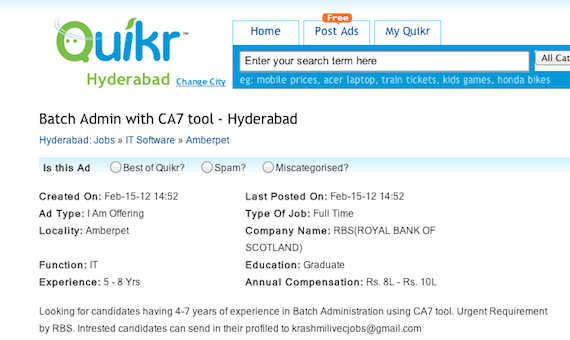
Back during the last few years of the last millennium, the more enterprising or devious consulting companies made a small fortune by telling their clients that unless they were careful their computer systems could fall apart when the first digit of the year switched from a 1 to a 2.
As it turned out, although dates are widely used in computer programs, either all the developers figured out this once in a thousand year event when they were writing the code, or it was very easy to track down where dates were used and make sure there were no foul-ups. Net, net there were no great disasters on 1.1.2000.
But come the next century, those consultants had to find something to do, and that turned out to be outsourcing. For £250 an hour a big consulting firm could tell a big bank how it could save money in the long term by firing its staff in the UK and replacing them with Indians who would be paid about the same as the UK minimum wage. A UK IT worker might be costing about £60-70k once all the NI, pension rights and the rest were factored in, plus the overhead, whereas an Indian graduate with 5-8 years experience would cost about 10k (see above).
Which is all a shame when the system goes tits up because some junior operator in India, unsupervised by anyone in the UK, screws up a system update, places the same update on the live and the back up machines and then messes up the back out of those updates.
The outcome: a fall in the value of the shares owned by you (as a tax payer) of £1.7 billion, which dwarves any costs or losses due to the Millennium bug.
Tuesday, 26 June 2012
What we can learn from Sarf Lundun
Recently the Parliamentary Treasury Select Committee found that ""PFI should be brought on balance sheet. The Treasury should remove any perverse incentives unrelated to value for money by ensuring that PFI is not used to circumvent departmental budget limits. It should also ask the OBR to include PFI liabilities in future assessments of the fiscal rules".
By October 2007 the total capital value of PFI contracts signed throughout the UK was £68bn, committing the British taxpayer to future spending of £215 bn over the life of the contracts. The global financial crisis which began in 2007 presented PFI with difficulties because many sources of private capital had dried up. Nevertheless PFI remained the UK government's preferred method for public sector procurement under both Labour and the present coalition. In January 2009 the Labour Secretary of State for Health, Alan Johnson, reaffirmed this commitment with regard to the health sector, stating that “PFIs have always been the NHS’s ‘plan A’ for building new hospitals … There was never a ‘plan B’".
However, because of banks' unwillingness to lend money for PFI projects, the UK government now had to fund the so-called 'private' finance initiative itself. In March 2009 it was announced that the Treasury would lend £2bn of public money to private firms building schools and other projects under PFI.
Labour's Chief Secretary to the Treasury, Yvette Cooper, claimed the loans should ensure that projects worth £13bn — including waste treatment projects, environmental schemes and schools — would not be delayed or cancelled. She also promised that the loans would be temporary and would be repaid at a commercial rate. But, at the time, Vince Cable of the Liberal Democrats, subsequently Secretary of State for Business in the coalition, argued in favour of traditional public financing structures instead of propping up PFI with public money:
The whole thing has become terribly opaque and dishonest and it's a way of hiding obligations. PFI has now largely broken down and we are in the ludicrous situation where the government is having to provide the funds for the private finance initiative.
In opposition at the time, even the Conservative Party considered that, with the taxpayer now funding it directly, PFI had become "ridiculous". Philip Hammond, subsequently Secretary of State for Transport in the coalition, said:
If you take the private finance out of PFI, you haven’t got much left . . . if you transfer the financial risk back to the public sector, then that has to be reflected in the structure of the contracts. The public sector cannot simply step in and lend the money to itself, taking more risk so that the PFI structure can be maintained while leaving the private sector with the high returns these projects can bring. That seems to us fairly ridiculous.
In an interview in November 2009, Conservative George Osborne, subsequently Chancellor of the Exchequer in the coalition, sought to distance his party from the excesses of PFI by blaming Labour for its misuse, despite it still bearing all the hallmarks of the policy devised by his own party. At the time, Osborne proposed a modified PFI which would preserve the arrangement of private sector investment for public infrastructure projects in return for part-privatisation, but would ensure proper risk transfer to the private sector along with transparent accounting:
Labour's PFI model is flawed and must be replaced. We need a new system that doesn't pretend that risks have been transferred to the private sector when they can't be, and that genuinely transfers risks when they can be . . . On PFI, we are drawing up alternative models that are more transparent and better value for taxpayers. The first step is transparent accounting, to remove the perverse incentives that result in PFI simply being used to keep liabilities off the balance sheet. The government has been using the same approach as the banks did, with disastrous consequences. We need a more honest and flexible approach to building the hospitals and schools the country needs. For projects such as major transport infrastructure we are developing alternative models that shift risk on to the private sector. The current system – heads the contractor wins, tails the taxpayer loses – will end.
Despite being so critical of PFI while in opposition and promising reform, once in power George Osborne progressed 61 PFI schemes worth a total of £6.9bn in his first year as Chancellor. The truth is the coalition government have made a decision that they want to expand PFI at a time when the value for money credentials of the system have never been weaker. The government is very concerned to keep the headline rates of deficit and debt down, so it's looking to use an increasingly expensive form of borrowing through an intermediary knowing the investment costs won't immediately show up on their budgets.
So what do we learn from South London NHS? First of all that PFI is expensive, cripplingly expensive. Second that it doesn't transfer any risk At all. None, whatsoever. A private sector gopher may be replacing all the light bulbs at £200 a pop, if you'll pardon the expression, but there is no real transfer of risk because the public sector always needs the service, so when the public sector service recipient goes tits up, who steps in? Answer: you the tax payer, because the contingent liability loses its tingency (making the con very visible).
So why does the government persist in keeping PFI liabilities off the government balance sheet?
Monday, 25 June 2012
Reasons not to join the Euro
1. Staying out probably means that Blair won't be President of Europe.
I think that's enough
I think that's enough
Hester, Hester, Hester, Out, Out, Out
A NatWest Spokesman tells us:
Glad to know it is technical, not biological, but 'technical' carriues the implication, that they don't know what the problem is. However, the problem is believed to have arisen following a software update to the payment processing systems of Natwest's parent company RBS.
According to a spokesman from Compuware, whoever they may be:
Train A goes something like:
We employ 1,000 IT staff and, because of this, all our systems run smoothly.
Train B, however, goes:
All our systems run smoothly, why do we need 1,000 IT staff?
Unfortunately, it's standing room only on Train B, while Train A has been cancelled due to lack of demand and a bus replacement service is now in operation.
On the plus-side, all RBS Group employees are forced to have an RBS/Natwest account into which their salary will be paid. This happens around the 24th of each month, which this month falls on a Sunday, so payments would be made the following working day. Which would be today.
How's your bank balance looking today Mr Hester?
We are continuing to experience technical issues with our systems, which is impacting a large number of our customers. As a result, money credited to accounts overnight may not be appearing on balances today.Which is a great way to tell us about our relationship with our money, and how it is handled, but there is more. NatWest re-iterated that the problem is “strictly of a technical nature”, although it declined to provide further detail on the issues it faces.
Glad to know it is technical, not biological, but 'technical' carriues the implication, that they don't know what the problem is. However, the problem is believed to have arisen following a software update to the payment processing systems of Natwest's parent company RBS.
According to a spokesman from Compuware, whoever they may be:
The problem is that IT systems have become vastly more complex. Delivering an e-banking service could be reliant on 20 different IT systems. If even a small change is made to one of these systems, it can cause major problems for the whole banking service, which could be what’s happened at NatWest. Finding the root cause of the problem is probably something NatWest is struggling with because of the complexity of the IT systems in any bank.All the more reason then to keep the IT department in house. However that is not how it works. NatWest/RBS have fired thousands of back room staff and outsourced their jobs to India. In modern business there are two trains of thought that exist in management.
Train A goes something like:
We employ 1,000 IT staff and, because of this, all our systems run smoothly.
Train B, however, goes:
All our systems run smoothly, why do we need 1,000 IT staff?
Unfortunately, it's standing room only on Train B, while Train A has been cancelled due to lack of demand and a bus replacement service is now in operation.
On the plus-side, all RBS Group employees are forced to have an RBS/Natwest account into which their salary will be paid. This happens around the 24th of each month, which this month falls on a Sunday, so payments would be made the following working day. Which would be today.
How's your bank balance looking today Mr Hester?
Friday, 15 June 2012
Let's play a game
So the president of Argentina, Cristina Fernandez de Kirchner has demanded that Britain enter negotiations over the sovereignty of the Falkland Islands. Funny name for an Argentinian, Kirchner. Sounds almost German. Well actually it is, but let us leave that aside for the moment.
Let's play a game. Charades. I'll start. Well known phrase. Two words. Second word: off.
The British know all about Argentinians and Germans who want to help themselves to bits of other people's countries. We are on a 3 match winning streak and I think we would look to be favourites in this game.
Wednesday, 13 June 2012
Klutz of the day
You can tell how an iundependent Scotland would be run by the calibre of the people running Scottish businesses, siuch as the banks and its larger football clubs. In both cases, downright appalling. Considering how easy it is for the top 2 clubs to stay in business with the almost hitherto guaranteed dose of Euro TV money, it takes a real incompetent to put one of them out of business,.
But it seems another kilted-know-nothing is lining up to set up a new Glasgow Rangers, and this particular numbskull thinks he can force the existing Rangers players to play for his new club under the TUPE rules.
Not so fast, Mr Green. The TUPE rules are their to protect employees' rights not to allow employers to coerce them into working for them.
As a general rule it is not legal to assign, sell or transfer an employment contract (i.e. McDonalds can’rt just package up all the employment contracts of all their staff and sell them to KFC). This is because to do so could amount to trading in people (i.e. slavery or indentures) which as a civilised person we do not do.
The exception to this is when a business, but not a company, is sold or even where a company or organisation stops doing something and a new party takes over the operation. In those circumstances it seems reasonable that the employees can expect that they will be transferred with the business so that they keep their jobs, and to the maximum extent possible keep their terms and conditions of employment.
But since it would be unreasonable to expect every employee would always want to work for the new employee, the law gives them the right to opt out. But it never made it legal for employers to sell their staff in other circumstances. But when the putative transferor is insolvent TUPE does not apply, so while the employee gets no protection from TUPE, but the transfer of the contract would not be binding on the employee. without consent. It simply lapses when the transferor is liquidated.
But it seems another kilted-know-nothing is lining up to set up a new Glasgow Rangers, and this particular numbskull thinks he can force the existing Rangers players to play for his new club under the TUPE rules.
Not so fast, Mr Green. The TUPE rules are their to protect employees' rights not to allow employers to coerce them into working for them.
As a general rule it is not legal to assign, sell or transfer an employment contract (i.e. McDonalds can’rt just package up all the employment contracts of all their staff and sell them to KFC). This is because to do so could amount to trading in people (i.e. slavery or indentures) which as a civilised person we do not do.
The exception to this is when a business, but not a company, is sold or even where a company or organisation stops doing something and a new party takes over the operation. In those circumstances it seems reasonable that the employees can expect that they will be transferred with the business so that they keep their jobs, and to the maximum extent possible keep their terms and conditions of employment.
But since it would be unreasonable to expect every employee would always want to work for the new employee, the law gives them the right to opt out. But it never made it legal for employers to sell their staff in other circumstances. But when the putative transferor is insolvent TUPE does not apply, so while the employee gets no protection from TUPE, but the transfer of the contract would not be binding on the employee. without consent. It simply lapses when the transferor is liquidated.
Monday, 11 June 2012
No idea what this means

Well actually I think it is something to do with an "initiative" (πρωτοβουλία) by "journalists" (δημοσιογράφων), but I like this free advertising from Greece.
Sunday, 10 June 2012
Our politicians aren't alone
Our politicians certainly come up with a lot of tripe from time to time, but they have competition in that field.
Spanish Prime Minister Mariano Rajoy has hailed a decision by eurozone finance ministers to help Spain shore up its struggling banks as a victory for the European common currency. "It was the credibility of the euro that won," he told reporters.
And, presumably, the credibility of the Spanish PM that lost. After all only two weeks ago he was telling the world that Spain didn't need a bail out.
Pull the other one Pedro. How does an inter-government loan to several nearly bust financial institutions represent a victory for the currency? If the Spanish banks had been able to borrow in the public markets in their own currency, that would have been a victory for the currency, albeit a very minor one.
If that is a victory, lend me a billion, and win again
Spanish Prime Minister Mariano Rajoy has hailed a decision by eurozone finance ministers to help Spain shore up its struggling banks as a victory for the European common currency. "It was the credibility of the euro that won," he told reporters.
And, presumably, the credibility of the Spanish PM that lost. After all only two weeks ago he was telling the world that Spain didn't need a bail out.
Pull the other one Pedro. How does an inter-government loan to several nearly bust financial institutions represent a victory for the currency? If the Spanish banks had been able to borrow in the public markets in their own currency, that would have been a victory for the currency, albeit a very minor one.
If that is a victory, lend me a billion, and win again
Sunday, 3 June 2012
21 June is Visit your Doctor Day
Doctors have voted to go on strike on June 21. Their union, the British Medical Association, which is just a fancy name for a trade union, insists that the “industrial action” (their term, I'd called non-industrial inaction, but there you go) won’t harm anyone, so no doctor will break the Hippocratic Oath, which includes the clause “do no harm”.
The trouble is that doctors of course do a lot of harm to the economy, so be sure to make an urgent appointment with your GP to tell them that their high pay is an unnecdessary burden on the state. One of the post war socialists in government, I can't remember which, could have been a Bevin or a Bevan, warned that nationalising doctors could lead to doctors holding the government to ransom.
Doctors do a very valuable job; a job that requires a lot of training, paid for mostly by us, the tax payers. After that training they earn an average salary of over £100,000 a year, a pension after 40 years service worth over £50,000 index-linked and a £150,000 lump sum on retirement. Sounds pretty good to me, particularly considering the pension contributions of 8% over 40 years amount to 3 years salary, in return for which they will get a lump sum of 18 months salary and an expectation of 20 to 25 years pension. And becaus ethey might lose some of that they want to go on strike.
It is worth noting that half of the 1% of the most highly paid public sector workers work in the Health Service. Healthcare takes a disproportionate share of the national income and the reason is that like many public services, and unlike the private sector, it doesn't respond to market conditions.
Wagers iun the private sector have been driven down by competition from Asia. If you don't believe me, look at the wages in semiconductor fabrication. nott so long ago, we actually had some of those plants in the UK. Nowadays, they are all in the Far East. I rest my case.
but the doctors still think they should be paid as though they are servicing the healthcare needs of a vibrant workforce, when realistically it is more to do with hip operations of an ageing population. Sureenough they deserve care, but economically it ain't worth paying a lot for it, and by rights doctors should be earning a lot less when the government is running a deficit.
The docors may not like it, but part of the problem is that the costs of caring for the elderly have to be spread more thinly because we are all living longer, and the only people to blame for that are the doctors.
The trouble is that doctors of course do a lot of harm to the economy, so be sure to make an urgent appointment with your GP to tell them that their high pay is an unnecdessary burden on the state. One of the post war socialists in government, I can't remember which, could have been a Bevin or a Bevan, warned that nationalising doctors could lead to doctors holding the government to ransom.
Doctors do a very valuable job; a job that requires a lot of training, paid for mostly by us, the tax payers. After that training they earn an average salary of over £100,000 a year, a pension after 40 years service worth over £50,000 index-linked and a £150,000 lump sum on retirement. Sounds pretty good to me, particularly considering the pension contributions of 8% over 40 years amount to 3 years salary, in return for which they will get a lump sum of 18 months salary and an expectation of 20 to 25 years pension. And becaus ethey might lose some of that they want to go on strike.
It is worth noting that half of the 1% of the most highly paid public sector workers work in the Health Service. Healthcare takes a disproportionate share of the national income and the reason is that like many public services, and unlike the private sector, it doesn't respond to market conditions.
Wagers iun the private sector have been driven down by competition from Asia. If you don't believe me, look at the wages in semiconductor fabrication. nott so long ago, we actually had some of those plants in the UK. Nowadays, they are all in the Far East. I rest my case.
but the doctors still think they should be paid as though they are servicing the healthcare needs of a vibrant workforce, when realistically it is more to do with hip operations of an ageing population. Sureenough they deserve care, but economically it ain't worth paying a lot for it, and by rights doctors should be earning a lot less when the government is running a deficit.
The docors may not like it, but part of the problem is that the costs of caring for the elderly have to be spread more thinly because we are all living longer, and the only people to blame for that are the doctors.
Wednesday, 30 May 2012
Zuckerberg off the Billionaires Index
Still a billionaire though if you count worthless paper, but with FB shares fallling another 10% yesterday to put them at $10 below their offer price, Zuckerberg is no longer in the top 40 billionaires calculated daily by Bloomberg.
I said the value of this stock would decline inverse exponentially like lastminute.com, and judging by the graph, so far I am not wrong.
I said the value of this stock would decline inverse exponentially like lastminute.com, and judging by the graph, so far I am not wrong.
Let me restate that for you
In a letter to the prime minister, nearly 70 university heads are warning that changes to student visas would drive bright applicants away. They urge the government to take foreign students, who bring in £8bn a year, out of net immigration counts. In the letter, senior education figures called for the prime minister to class foreign students as temporary rather than permanent migrants. In their letter, the signatories expressed concern that Britain's higher education industry could be harmed by changes to immigration policy. Britain attracts around one in 10 students who study outside their home country, generating around £8bn a year in tuition fees, they said. This, they added, could increase to £17bn by 2025.
But ministers said the policy did not stop genuine students coming to the UK. Immigration Minister Damian Green said the government was "determined to prevent the abuse of student visas as part of our plans to get net migration down to the tens of thousands. Students coming to the UK for over a year are not visitors", he said. "Numbers affect communities, public services and infrastructure." But Mr Green pointed out that the Independent Office for National Statistics was responsible for producing net migration figures, which were based on an internationally agreed definition of a migrant - someone entering the country for more than a year. "Public confidence in statistics will not be enhanced by revising the way the net migration numbers are presented by removing students", he said.
Or if I may put it another way. University heads should realise that the economic impact of illegal migration is far greater than the paltry loss of revenue they might suffer as a result of these measures.
But ministers said the policy did not stop genuine students coming to the UK. Immigration Minister Damian Green said the government was "determined to prevent the abuse of student visas as part of our plans to get net migration down to the tens of thousands. Students coming to the UK for over a year are not visitors", he said. "Numbers affect communities, public services and infrastructure." But Mr Green pointed out that the Independent Office for National Statistics was responsible for producing net migration figures, which were based on an internationally agreed definition of a migrant - someone entering the country for more than a year. "Public confidence in statistics will not be enhanced by revising the way the net migration numbers are presented by removing students", he said.
Or if I may put it another way. University heads should realise that the economic impact of illegal migration is far greater than the paltry loss of revenue they might suffer as a result of these measures.
Monday, 28 May 2012
I give you a new verb
| A friend used a word yesterday that I feel deserves wider currency, so here is my new word for the day: outsmartphone (ˌaʊtˈsmɑːt.fəʊn) verb (transitive) 1. To own a telephone handset with a higher specification and performance than a telephone owned by another person. 2. To win at competitive telephone ownership. |
Wednesday, 23 May 2012
What's the mutter with that?
David Cameron has been rebuked for unparliamentary language after calling Ed Balls a "muttering idiot".
Don't see anything wrong with that. If it is good enough for Aristotle then it is good enough for our parliament. Idiot as a word derived from the Greek ἰδιώτης, idiōtēs ("person lacking professional skill", "a private citizen", "individual"), from ἴδιος, idios ("private", "one's own").In Latin the word idiota ("ordinary person, layman") preceded the Late Latin meaning "uneducated or ignorant person." Its modern meaning and form dates back to Middle English around the year 1300, from the Old French idiote ("uneducated or ignorant person"). The related word idiocy dates to 1487 and may have been analogously modeled on the words prophet and prophecy The word has cognates in many other languages.
An idiot in Athenian democracy was someone who was characterized by self-centeredness and concerned almost exclusively with private—as opposed to public—affairs. Idiocy was the natural state of ignorance into which all persons were born and its opposite, citizenship, was effected through formalized education. In Athenian democracy, idiots were born and citizens were made through education (although citizenship was also largely hereditary). "Idiot" originally referred to "layman, person lacking professional skill", "person so mentally deficient as to be incapable of ordinary reasoning". Declining to take part in public life, such as democratic government of the polis (city state), was considered dishonorable. "Idiots" were seen as having bad judgment in public and political matters. Over time, the term "idiot" shifted away from its original connotation of selfishness and came to refer to individuals with overall bad judgment–individuals who are "stupid".
According to the Bauer-Danker Lexicon, the noun ίδιωτής in ancient Greek meant "civilian", "private citizen" , "private soldier as opposed to officer," "relatively unskilled, not clever". The military connotation in Bauer's definition stems from the fact that ancient Greek armies in the time of total war mobilized all male citizens (to the age of 50) to fight, and many of these citizens tended to fight poorly and not very well.
Just like Ed Balls.
Don't see anything wrong with that. If it is good enough for Aristotle then it is good enough for our parliament. Idiot as a word derived from the Greek ἰδιώτης, idiōtēs ("person lacking professional skill", "a private citizen", "individual"), from ἴδιος, idios ("private", "one's own").In Latin the word idiota ("ordinary person, layman") preceded the Late Latin meaning "uneducated or ignorant person." Its modern meaning and form dates back to Middle English around the year 1300, from the Old French idiote ("uneducated or ignorant person"). The related word idiocy dates to 1487 and may have been analogously modeled on the words prophet and prophecy The word has cognates in many other languages.
An idiot in Athenian democracy was someone who was characterized by self-centeredness and concerned almost exclusively with private—as opposed to public—affairs. Idiocy was the natural state of ignorance into which all persons were born and its opposite, citizenship, was effected through formalized education. In Athenian democracy, idiots were born and citizens were made through education (although citizenship was also largely hereditary). "Idiot" originally referred to "layman, person lacking professional skill", "person so mentally deficient as to be incapable of ordinary reasoning". Declining to take part in public life, such as democratic government of the polis (city state), was considered dishonorable. "Idiots" were seen as having bad judgment in public and political matters. Over time, the term "idiot" shifted away from its original connotation of selfishness and came to refer to individuals with overall bad judgment–individuals who are "stupid".
According to the Bauer-Danker Lexicon, the noun ίδιωτής in ancient Greek meant "civilian", "private citizen" , "private soldier as opposed to officer," "relatively unskilled, not clever". The military connotation in Bauer's definition stems from the fact that ancient Greek armies in the time of total war mobilized all male citizens (to the age of 50) to fight, and many of these citizens tended to fight poorly and not very well.
Just like Ed Balls.
Is this a record?
3 Trading days - now that's impressive.
San Diego, CA -- (SBWIRE) -- 05/23/2012 -- An investor in NASDAQ:FB filed a lawsuit over alleged securities laws violations by Facebook and certain underwriters of the company’s IPO.
Investors who purchased shares of Facebook Inc (NASDAQ:FB) in or traceable to the IPO from Morgan Stanley, Goldman Sachs, and JPMorgan and/ or those who purchased shares of Facebook Inc (NASDAQ:FB) and had issues with the order on NASDAQ, have certain options and for certain investors are short and strict deadlines running. Deadline: July 23, 2012. NASDAQ:FB investors should contact the Shareholders Foundation, Inc.
The lawsuit was filed on behalf of all persons or entities who purchased the securities of Facebook Inc (NASDAQ:FB) pursuant and/or traceable to the Registration Statement and Prospectus issued in connection with Facebook's IPO (including investors who purchased shares through May 22, 2012). The plaintiff alleges, among others, that the offering materials provided to potential investors were negligently prepared and failed to disclose material information about Facebook’s business, operations and prospects, in violation of federal securities laws.
San Diego, CA -- (SBWIRE) -- 05/23/2012 -- An investor in NASDAQ:FB filed a lawsuit over alleged securities laws violations by Facebook and certain underwriters of the company’s IPO.
Investors who purchased shares of Facebook Inc (NASDAQ:FB) in or traceable to the IPO from Morgan Stanley, Goldman Sachs, and JPMorgan and/ or those who purchased shares of Facebook Inc (NASDAQ:FB) and had issues with the order on NASDAQ, have certain options and for certain investors are short and strict deadlines running. Deadline: July 23, 2012. NASDAQ:FB investors should contact the Shareholders Foundation, Inc.
The lawsuit was filed on behalf of all persons or entities who purchased the securities of Facebook Inc (NASDAQ:FB) pursuant and/or traceable to the Registration Statement and Prospectus issued in connection with Facebook's IPO (including investors who purchased shares through May 22, 2012). The plaintiff alleges, among others, that the offering materials provided to potential investors were negligently prepared and failed to disclose material information about Facebook’s business, operations and prospects, in violation of federal securities laws.
Tuesday, 22 May 2012
Faceplant
As speculation mounts over whether FB could set the record for the shortest period between IPO and class action lawsuit, Reuters reports:
Massachusetts Secretary of Commonwealth William Galvin has issued a subpoena to Morgan Stanley over an analyst's discussions with investors on Facebook.
"The Securities Division has put out a subpoena to Morgan Stanley in connection with the analyst's discussion with certain institutional investors about the revenue prospects for Facebook," a spokesman for Galvin's office said.
Word on The Street is that Goldman and Morgan Stanley revised down their opinion of FB just before the float, presumably after reading my tip. They may have told institutional investors, but left retail buyers out to dry. Allegedly.
Biggest faller on Friday amongst majors US stocks: FB fell from $42 at opening to $38, the initial offer price
Biggest faller on Monday amongst majors US stocks: FB fell from $38 at opening to $34, down 13%
Massachusetts Secretary of Commonwealth William Galvin has issued a subpoena to Morgan Stanley over an analyst's discussions with investors on Facebook.
"The Securities Division has put out a subpoena to Morgan Stanley in connection with the analyst's discussion with certain institutional investors about the revenue prospects for Facebook," a spokesman for Galvin's office said.
Word on The Street is that Goldman and Morgan Stanley revised down their opinion of FB just before the float, presumably after reading my tip. They may have told institutional investors, but left retail buyers out to dry. Allegedly.
Biggest faller on Friday amongst majors US stocks: FB fell from $42 at opening to $38, the initial offer price
Biggest faller on Monday amongst majors US stocks: FB fell from $38 at opening to $34, down 13%
Biggest faller on Tuesday amongst majors US stocks: FB fell from $38 at opening to $31, down 8.9%.
Not really a chartist but I think I see a trend.
Monday, 21 May 2012
Picture = 1,000 words

Last Friday was price support day from the underwriters who kept the price at $38 a share. But this is a brand new week, price support is off and FB share price is down 13% in the first 45 minutes. That's a $13.5 billion loss of theoretical value.
There goes nothing. Hope you all took my tip last week and shorted.
Saturday, 19 May 2012
You couldn't make it up #94
It's been a pretty busy week here at the Financial Crimes with a lot of incoming readership from Zero Hedge, all because of a post I made a few years ago about Matt Zames, rising star at JPM.
Well it seems that not a lot of people spotted that Mr Zames was fingered in a court deposition as having suspicions about Bernie Madoff 18 months before the NY District Attorney got wind and closed him down. Zames' suspicions were strong enough for him to mention them to a JPM risk officer, but obviously not strong enough to go to the authorities.
Anyway, the reason that Mr Zames, who incidentally is chairman of the Treasury Borrowing Advisory Committee (not bad going for a trader who worked at LTCM, the hedge fund whose failure was so large that it was bailed out to the tune of $3,625 million by US banks under the supervision of the Fed), is now in the news is that he has been but in charge of the $70 trillion derivatives book in the Central Investment Office at JPM.
Between Madoff, LTCM, the stinking carcass of the London Whale and telling the US government how much to borrow, something doesn't smell right.
Well it seems that not a lot of people spotted that Mr Zames was fingered in a court deposition as having suspicions about Bernie Madoff 18 months before the NY District Attorney got wind and closed him down. Zames' suspicions were strong enough for him to mention them to a JPM risk officer, but obviously not strong enough to go to the authorities.
Anyway, the reason that Mr Zames, who incidentally is chairman of the Treasury Borrowing Advisory Committee (not bad going for a trader who worked at LTCM, the hedge fund whose failure was so large that it was bailed out to the tune of $3,625 million by US banks under the supervision of the Fed), is now in the news is that he has been but in charge of the $70 trillion derivatives book in the Central Investment Office at JPM.
Between Madoff, LTCM, the stinking carcass of the London Whale and telling the US government how much to borrow, something doesn't smell right.
Friday, 18 May 2012
They just keep coming
It's pretty hard for a bank to lose a billion all of a sudden, but when, like JPM, it is hiding a hedge fund amongst its federally insured businesses, it happens very quickly as the $2 billion loss of less than a week ago seems to have doubled. A billion here, a billion there and pretty soon you are talking serious money. much more of this and JPM will be looking for a new CEO.
Sell Facebook
Facebook is going public with a valuation of $104 billion, although they are only selling $16 billion worth of shares. Here's a tip. At that price avoid it like the plague. In fact, short the plague. Put all your assets into shorting the stock. The price won't last, just like the radioactive decay that was Lastminute.com. And here's why:
Capped Revenues
Facebook makes its money from selling advertising space based on the information supplied by users. And it says it has a lot of users, about 845 million. So far, so smart. Facebook is currently valued at 100 times earnings, which sounds fine for an internet startup that has been around for a few years, but not so smart for a company that claims to have 70% of internet users signed up. There isn't much room for growth there, and certainly no way to grow the revenues to bring up the "e" in the p/e ratio so that it hits the 8 to 12 expected of a mature company. Expect the "p" to fall.
Ever growing cost base
Unlike many internet companies, Facebook does have financial data, but the picture it shows is not that great. It is profitable and it is growing fast, but the problem is that Facebook is not like most internet companies where the fantastic profits come because of the incredible scalability of the internet. At Facebook the rapidly increasing revenues are closely followed by rapidly increasing expenses.
That is not how it is supposed to work. The idea of an internet venture is that you invest all your money up front in development and then you sit back while your fixed cost base produces an ever increasing revenue stream. The trouble with Facebook is that this year's cost base is higher than last years revenues. Eventually the revenues will stop growing and this year's bright star will become next year's dog.
New Entrants
Give me $104 billion and I can build a rival product that will eat into Facebook revenues. Easy. In fact give me $104 *million* and I can do the same. So give me $1 billion and I can build a rival product, hand over $1 to every Facebook user who switches to my system and pay them $1 in cash, which is roughly all you would have to pay to get people to switch.
Existing Competitors
Actually, you don't need to worry about any new businesses because there are plenty of other companies that can advertise in your face while online and they have better business models.
Nobody gets onto Facebook to go shopping.
Ebay, Amazon and Google know what I want to buy because I search for it on their websites.
Facebook knows my favourite colour.
Ebay, Amazon and Google know that I want a 5V micro USB power supply, solid oak gate posts, hard to find cupboard hinges and a new satnav.
Facebook knows that I like the bands whose CD's I already own, and where I went on holiday last year.
I probably want to go somewhere else this year. I will check out that somewhere else on Google, thank you very much.
The World Moves On
Facebook started as a desktop system, but the world is going mobile. The IPO prospectus mentions the word "mobile" 123 times, and 425 million of the 845 million monthly active users (MAUs) at December 31, 2011 are mobile users. Mobile users are growing faster than other users, and expect that trend to increase if Facebook breaks into China where mobile phone usage far exceeds internet connections.
Facebook do not make any money out of mobile users. The prospectus says "We do not currently directly generate any meaningful revenue from the use of Facebook mobile products, and our ability to do so successfully is unproven". Worse still the prospectus says that the company's revenue growth could be harmed if it cannot "successfully implement monetization strategies for our mobile users".
Could? Make that will.
Crap Management
Zuckerberg. Say no more. He actually says he doesn't really care about advertisers. Do you really think he will care about shareholders once he has your money? Dream on.
Falling profits
To justify such a high p/e Facebook needs to be growing its profits. Sadly they fell 32% between Q4 2011 and Q1 2012. And revenues were down 6.5%.
At $104 billion this is a no-brainer. And if you want a feel for how screwed you would be, the shares on offer are "A" shares, which carry one vote per share, as is normal, but the current owners' shares are "B" shares, which carry 10 votes each. Zuckerberg will own less that 50% of the shares, but 56% of the votes. Go for it suckers.
Capped Revenues
Facebook makes its money from selling advertising space based on the information supplied by users. And it says it has a lot of users, about 845 million. So far, so smart. Facebook is currently valued at 100 times earnings, which sounds fine for an internet startup that has been around for a few years, but not so smart for a company that claims to have 70% of internet users signed up. There isn't much room for growth there, and certainly no way to grow the revenues to bring up the "e" in the p/e ratio so that it hits the 8 to 12 expected of a mature company. Expect the "p" to fall.
Ever growing cost base
Unlike many internet companies, Facebook does have financial data, but the picture it shows is not that great. It is profitable and it is growing fast, but the problem is that Facebook is not like most internet companies where the fantastic profits come because of the incredible scalability of the internet. At Facebook the rapidly increasing revenues are closely followed by rapidly increasing expenses.
That is not how it is supposed to work. The idea of an internet venture is that you invest all your money up front in development and then you sit back while your fixed cost base produces an ever increasing revenue stream. The trouble with Facebook is that this year's cost base is higher than last years revenues. Eventually the revenues will stop growing and this year's bright star will become next year's dog.
New Entrants
Give me $104 billion and I can build a rival product that will eat into Facebook revenues. Easy. In fact give me $104 *million* and I can do the same. So give me $1 billion and I can build a rival product, hand over $1 to every Facebook user who switches to my system and pay them $1 in cash, which is roughly all you would have to pay to get people to switch.
Existing Competitors
Actually, you don't need to worry about any new businesses because there are plenty of other companies that can advertise in your face while online and they have better business models.
Nobody gets onto Facebook to go shopping.
Ebay, Amazon and Google know what I want to buy because I search for it on their websites.
Facebook knows my favourite colour.
Ebay, Amazon and Google know that I want a 5V micro USB power supply, solid oak gate posts, hard to find cupboard hinges and a new satnav.
Facebook knows that I like the bands whose CD's I already own, and where I went on holiday last year.
I probably want to go somewhere else this year. I will check out that somewhere else on Google, thank you very much.
The World Moves On
Facebook started as a desktop system, but the world is going mobile. The IPO prospectus mentions the word "mobile" 123 times, and 425 million of the 845 million monthly active users (MAUs) at December 31, 2011 are mobile users. Mobile users are growing faster than other users, and expect that trend to increase if Facebook breaks into China where mobile phone usage far exceeds internet connections.
Facebook do not make any money out of mobile users. The prospectus says "We do not currently directly generate any meaningful revenue from the use of Facebook mobile products, and our ability to do so successfully is unproven". Worse still the prospectus says that the company's revenue growth could be harmed if it cannot "successfully implement monetization strategies for our mobile users".
Could? Make that will.
Crap Management
Zuckerberg. Say no more. He actually says he doesn't really care about advertisers. Do you really think he will care about shareholders once he has your money? Dream on.
Falling profits
To justify such a high p/e Facebook needs to be growing its profits. Sadly they fell 32% between Q4 2011 and Q1 2012. And revenues were down 6.5%.
At $104 billion this is a no-brainer. And if you want a feel for how screwed you would be, the shares on offer are "A" shares, which carry one vote per share, as is normal, but the current owners' shares are "B" shares, which carry 10 votes each. Zuckerberg will own less that 50% of the shares, but 56% of the votes. Go for it suckers.
Thursday, 17 May 2012
Never mind, there's always another time
We note from the Court Pages of the national newspapers that Queen Sofia of Spain has been ordered to down turn an invitation from Queen Elizabeth to a Diamond Jubilee lunch for the world's sovereign monarchs because of Spain's persistent niggling over Gibraltar.
Queen Sofia had earlier accepted the invite to tomorrow's (Friday's) celebration at Windsor Castle, but in a last minute snub by Spain's government she has been told not to attend because it would be "inappropriate in the current circumstances".
Never mind, perhaps she would like to come back next April to celebrate the 300th anniversary of the Treaty of Utrecht.
And of course, it could all be just a ploy to divert attention from the massive cost of borrowing for the Spanish government in today's news.
Queen Sofia had earlier accepted the invite to tomorrow's (Friday's) celebration at Windsor Castle, but in a last minute snub by Spain's government she has been told not to attend because it would be "inappropriate in the current circumstances".
Never mind, perhaps she would like to come back next April to celebrate the 300th anniversary of the Treaty of Utrecht.
And of course, it could all be just a ploy to divert attention from the massive cost of borrowing for the Spanish government in today's news.
Monday, 14 May 2012
Yahoo! CEO! quits!
The Chief Executive of Yahoo! Scott Thompson has resigned two weeks after it was revealed that he did not have a Computer Science degree as claimed, but an accounting degree. Which is a shame, because his CV is filed as part of the corporate filings with the SEC and that is a bit bad.
His real crime of course was to have such an appalling moustache. It takes a certain panache or dress sense to carry off the modern business-suit-with-no-tie look. It rarely works, but your chances of success with a '70s style Mexican dollop of fluff on the top lip is never going to work.

The funny bit about this story was that Mr Thompson was not alone in his misdemeanours. Patti Hart, chief executive of International Game Technology and a Yahoo director since 2010, who was tasked with finding a new CEO, had her own qualifications come under scrutiny. An investor alleged in a letter to the Yahoo board on Monday that she had exaggerated her academic background in claiming a bachelor’s degree in marketing and economics from Illinois State University, when she had in fact gained a business administration degree.
Personally I don't see much of a difference.
His real crime of course was to have such an appalling moustache. It takes a certain panache or dress sense to carry off the modern business-suit-with-no-tie look. It rarely works, but your chances of success with a '70s style Mexican dollop of fluff on the top lip is never going to work.
The funny bit about this story was that Mr Thompson was not alone in his misdemeanours. Patti Hart, chief executive of International Game Technology and a Yahoo director since 2010, who was tasked with finding a new CEO, had her own qualifications come under scrutiny. An investor alleged in a letter to the Yahoo board on Monday that she had exaggerated her academic background in claiming a bachelor’s degree in marketing and economics from Illinois State University, when she had in fact gained a business administration degree.
Personally I don't see much of a difference.
Friday, 11 May 2012
JPM make the case for Glass Steagall
The content and tone of JP Morgan chief Jamie Dimon’s telephone call to analysts explaining JP Morgan Chase’s regulatory filing to the Securities and Exchange Commission reporting a $2 billion loss in derivative trading demonstrates that the true cost to the bank should be measured in ideational and reputational terms.
The trading loss was an “egregious” error, the result of ‘self-inflicted’ mistakes that ‘violate our own standards and principles’ and which “plays right into the hands of a whole bunch of pundits out there,” he conceded.
The reputational damage is magnified by the fact that the losses reflected poor risk management within what the firm terms its Chief Investment Office. Buried within the filing (page 9), the firm notes that the “CIO has had significant mark-to-market losses in its synthetic credit portfolio, and this portfolio has proven to be riskier, more volatile and less effective as an economic hedge than the Firm previously believed.”
The frank admission of “sloppiness and bad judgement,” and determination that the firm would “admit it, we will learn from it, we will fix it, and we will move on” was an exercise in damage limitation.
Or in other words, banks that take government guaranteed deposits cannot be trusted to trade the funds they hold. If JPM, source of Value at Risk and the credit swap can mess up to the tune of $2 billion, what are the chances of the 1st Investment Bank of Mudville not making the same mistake? It is hard to see a $2 billion loss arising on a portfolio of secured loans to medium sized industrials. At least, not as an "egregious error" that pops up overnight.
Meanwhile, JPM directors have effectively overstated prior trading profits by $2billion and trousered the ensuing bonuses and LTIP payouts.
Tuesday, 8 May 2012
A word of thanks
to all the French voters, who have cut the cost of this year's summer holiday.
In a move that I think in fairness one would have to call courageous, the French electorate have decided that the solution to an over-borrowed state sector that already amounts to 56% of the economy is to spend more money that they don't have and will need to borrow.
This has of course had the obvious effect of reducing the value of the euro, making French holidays that much more enjoyable in sterling terms and possibly reducing the cost of my next German built car, albeit that that has raw materials and components priced in dollars.
In a move that I think in fairness one would have to call courageous, the French electorate have decided that the solution to an over-borrowed state sector that already amounts to 56% of the economy is to spend more money that they don't have and will need to borrow.
This has of course had the obvious effect of reducing the value of the euro, making French holidays that much more enjoyable in sterling terms and possibly reducing the cost of my next German built car, albeit that that has raw materials and components priced in dollars.
Monday, 30 April 2012
One Harry Redknapp
One Harry Redknapp
There's only one Harry Redknapp
One Ha-arrry Re-edknapp
There's only one err.... Roy Hodgson
One Ro-oy Hodgson
There's only one Ro-oy Hodgson
One Ro-o-oy Hodgson ......
Lest we forget, although Roy Hodgson scored no goals during his time as an 18 year old on the books at Crystal Palace in the 1960s, this was hardly his fault because he never actually made any appearances. However, he did go on to forge a successful playing career at such household names as Tonbridge Angels, Gravesend & Northfleet, Maidstone United, Ashford Town, Berea Park, Carshalton Athletic the last of which recently made its mark by winning League Division 1 and earning promotion to the Championship, oh no, sorry that was Charlton Athletic.
There's only one Harry Redknapp
One Ha-arrry Re-edknapp
There's only one err.... Roy Hodgson
One Ro-oy Hodgson
There's only one Ro-oy Hodgson
One Ro-o-oy Hodgson ......
Lest we forget, although Roy Hodgson scored no goals during his time as an 18 year old on the books at Crystal Palace in the 1960s, this was hardly his fault because he never actually made any appearances. However, he did go on to forge a successful playing career at such household names as Tonbridge Angels, Gravesend & Northfleet, Maidstone United, Ashford Town, Berea Park, Carshalton Athletic the last of which recently made its mark by winning League Division 1 and earning promotion to the Championship, oh no, sorry that was Charlton Athletic.
Thursday, 26 April 2012
Rough Diamond
Barclays have an AGM coming up so it is just as well for Bob Diamond that they announced an increase in basic earnings per share to 13.6p from 10.7p, although they held their interim dividend at 1p. After all, Mr Diamond is going to face a lot of criticism over his £11 million pay package for 2011, and that figure excludes a lot of tax liabilities the bank assumed on his relocation. Apparently another £7 million.
However, things are not so rosy in the Barclays cap because the £2.4 billion that is being reported to shareholders omits two big chunks of dosh.
First, the bank put aside another £300 million to meet the cost of mis-sold PPI (payment protection insurance) policies. This comes on top of £1 billion already set aside to pay compensation to swindled borrowers. Funny how the bank booked the PPI sales as ordinary income in the past, but when it comes to pay compensation this is not part of its reported trading profits.
In the same vein there is an even bigger biggie, a loss of more than £2.6 billion on the fair value of their own debt. We have covered this before. When the credit rating of banks deteriorates, they claim that the fair value of the debt they have already issued reduces because a higher discount rate is applied to value that debt, so they book a profit.
Similarly when the creditworthiness of the bank improves and the spread on their debt tightens, they will suffer a loss. To my mind there is nothing wrong with saying that there is an extraordinary loss. The prior debt was always going to be repaid so I would happily forget this fair value charade. However, in the first nine months of 2011, Barclays' results were flattered by a £3 billion gain in the value of its own debt, so I see no reason why this figure is not also included in ordinary profits.
Taking these two figures into account, Barclays actually lost £475 million before tax, compared with a profit before tax of £1.7 billion last year.
Some people might think that makes them worth £11 million. Shine on you crazy, Diamond.
However, things are not so rosy in the Barclays cap because the £2.4 billion that is being reported to shareholders omits two big chunks of dosh.
First, the bank put aside another £300 million to meet the cost of mis-sold PPI (payment protection insurance) policies. This comes on top of £1 billion already set aside to pay compensation to swindled borrowers. Funny how the bank booked the PPI sales as ordinary income in the past, but when it comes to pay compensation this is not part of its reported trading profits.
In the same vein there is an even bigger biggie, a loss of more than £2.6 billion on the fair value of their own debt. We have covered this before. When the credit rating of banks deteriorates, they claim that the fair value of the debt they have already issued reduces because a higher discount rate is applied to value that debt, so they book a profit.
Similarly when the creditworthiness of the bank improves and the spread on their debt tightens, they will suffer a loss. To my mind there is nothing wrong with saying that there is an extraordinary loss. The prior debt was always going to be repaid so I would happily forget this fair value charade. However, in the first nine months of 2011, Barclays' results were flattered by a £3 billion gain in the value of its own debt, so I see no reason why this figure is not also included in ordinary profits.
Taking these two figures into account, Barclays actually lost £475 million before tax, compared with a profit before tax of £1.7 billion last year.
Some people might think that makes them worth £11 million. Shine on you crazy, Diamond.
Root and branch
Not particularly interested in the media conflab about BSkyB, Murdoch, DCMS, Lenson but a couple of things are quite clear. First of all, none of the current set of ministers, let alone the lot from the last government, has a clue about straightforward business dealings, open and fair discussion. The difference between politicians and businesses is that businesses have to face up to reality because if they don't they will be wiped out whereas politicians try to abuse their power, hide from the truth and obfuscate. It works for a while or until enough people have forgotten about a particular slip up and the politicians get away with it, but it makes for poor government.
Anyway, the one thing that is glaringly obvious is that Jeremy Hunt was inept in his handling of the BSkyB takeover, and it is clear that such rank amateurs should be nowhere near important decisions. But it raises the bigger issue of whether we actually need a Department of Culture, Media and Sport, any more than we need a Ministry of, say, Bricklaying? Sport and Culture existed long before the dead hand of government came into play, and while some aspects may benefit from government funding, that could probably be better handled by local government, by large national institutions (e.g. the National Gallery) funded directly by the Treasury or the National Lottery.
And as for media regulation, why should it be any different from any other business regulation? It is after all a business not an art and should be treated no differently than any other industry.
If there is one thing that can be learnt from the NOTW closure it is that incompetence and ineptitude can be most easily rooted out by closing down the whole organisation.
Anyway, the one thing that is glaringly obvious is that Jeremy Hunt was inept in his handling of the BSkyB takeover, and it is clear that such rank amateurs should be nowhere near important decisions. But it raises the bigger issue of whether we actually need a Department of Culture, Media and Sport, any more than we need a Ministry of, say, Bricklaying? Sport and Culture existed long before the dead hand of government came into play, and while some aspects may benefit from government funding, that could probably be better handled by local government, by large national institutions (e.g. the National Gallery) funded directly by the Treasury or the National Lottery.
And as for media regulation, why should it be any different from any other business regulation? It is after all a business not an art and should be treated no differently than any other industry.
If there is one thing that can be learnt from the NOTW closure it is that incompetence and ineptitude can be most easily rooted out by closing down the whole organisation.
Sunday, 22 April 2012
Yellowwash
Lots of bleating in the media today about Michael Brown, particularly from the LibDems about the Electoral Commission allowing them to keep £2.4 million of stolen money because they acted in "good faith". Actually the Electoral Commission did nothing of the sort. The good faith contention came from the LibDems, but as we all know, their leadership was drunk at the time. What the Electoral Commission said is recorded here, and the relevant extract was:
The fact that the Electoral Commission didn't prosecute is down to a "political decision" by the Electoral Commission, originally by Sam Wardle the former Chief Executive. I was the original complainant in May 2005 about Michael Brown, a few hours after the donation was announced (and I had done enough checks to spot that the donation was fishy). I complained through my MP. When there was no response after several months, he collared the Sam Wardle at his party conference. Still nothing happened, and months later when pushed, the Electoral Commission said that they couldn't comment while Brown was under investigation by the police. When I eventually reached Wardle by telephone, he said that it was unlikely the Electoral Commission would do anything because it was their job to preserve democracy, not to bankrupt political parties.
To be a permissible donor, a company must be registered under the Companies Act 1985, incorporated within the UK or another EU member state, and be carrying on business in the UK. The Commission has concluded that 5th Avenue Partners Limited met these requirements at the time the donations were made, and therefore was a permissible donor.
The Commission also considered whether there was a basis for concluding that either Michael Brown, as an individual, or 5th Avenue Partners GmbH (the parent company of 5th Avenue Partners Limited) was in fact the true donor. Neither of them would have qualified as permissible donors under PPERA.
The Commission has concluded that there is no reasonable basis to conclude that the true donor was someone other than 5th Avenue Partners Limited.
which all sounds fine and dandy except that when Brown was tried and convicted oif fraud, the High Court convinced themselves and made clear in their judgement that there was absolutely no business involved in 5th Avenue Partners.The fact that the Electoral Commission didn't prosecute is down to a "political decision" by the Electoral Commission, originally by Sam Wardle the former Chief Executive. I was the original complainant in May 2005 about Michael Brown, a few hours after the donation was announced (and I had done enough checks to spot that the donation was fishy). I complained through my MP. When there was no response after several months, he collared the Sam Wardle at his party conference. Still nothing happened, and months later when pushed, the Electoral Commission said that they couldn't comment while Brown was under investigation by the police. When I eventually reached Wardle by telephone, he said that it was unlikely the Electoral Commission would do anything because it was their job to preserve democracy, not to bankrupt political parties.
Subscribe to:
Posts (Atom)